Story time optional

Picture books you can read together on this site.

From the library

Free with a library card. Availability varies.

Windowby Jeannie BakerBorrow in LibbyA Log's Lifeby Wendy PfefferBorrow in Libby

Standards this week

The same codes and I Can statements as the printed books.

Books by grade

Grade 1

  • 1.4I can compare life across past places and identify change and continuity.
  • 1.4.1I can compare schools and communities in the past.

Science

Not in the Grade 1 Science book this week.

Grade 2

Social Studies

Not in the Grade 2 Social Studies book this week.

  • 2-ESS1-1I can compare rapid and slow events that change Earth.
Grade 1 Social Studies book, p. 92–93
In your book

Session 1, Read and notice: Windows into earlier places

Week 25 big question: What changed, and what stayed the same?

Start with a story (optional) Then and Now — Read it hereChiltari asks his father what their city was like long ago.

A photo shows just one time and place.

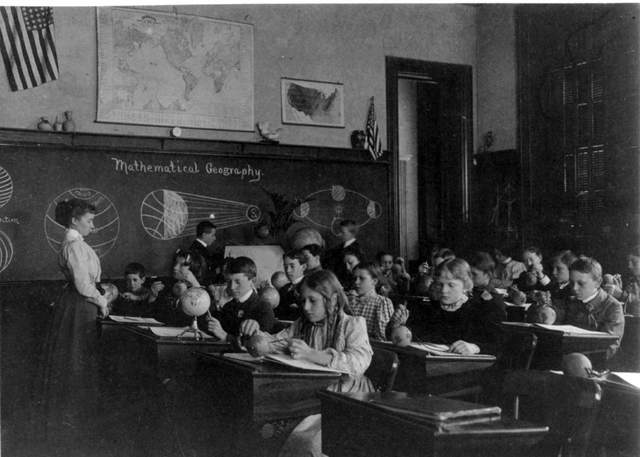
What would a photo of your lesson show someone years from now? A photo from Washington, D.C., around 1899 holds one such clue. It is a record, something kept that tells about a time. This one shows students looking at globes. Another shows girls studying a reading lesson. Those girls were at Lincoln Bench School in Oregon in 1939.

Both school photos show kids at work on a lesson.

The children had different lessons, but both groups were busy learning. Perhaps you use a globe or a book at a table, too. Or you may learn on a screen and take lessons outside. As you look at these children, compare their schools with yours. Remember, though, that their photos cannot show how every child learned. Nor can they tell us who could not attend those schools.

Some things change, and some stay the same.

People also gathered outside school to share ideas and make choices. A third photo shows a camp council meeting in Farmersville, California, in 1939. Farmworker communities could meet to talk about needs they shared. People still do that today, though buildings, tools, and meeting places may change. When people keep learning and working together, we see continuity. Continuity means something that stays the same through change. Look again at a past record beside something you see today. What changed, and what can you still recognize?

Show what you notice

  1. How were the two school photos alike? How were they different?
  2. What does the camp council photo show? What can it not tell us?

Answer your waypointact it outtell or dictatewrite

Grade 2 Science book, p. 88–90
In your book

Session 2, Investigate: Changes with different clocks

Some land changes are fast, and some are slow.

Rocks tumble down a slope, and the land changes in seconds. Yet a quiet valley can be changing while you watch, too. Flowing water carries away tiny bits of rock again and again. Each bit is small, but together they slowly change the land. Even at the Grand Canyon, rivers still help wear away rock. To compare that slow change with a sudden rockfall, we need two clues. How much land moved, and how long did it take? Together, those clues tell us the rate, or speed, of change. Our tray model uses one quick push and small spoonfuls to show two rates. Next time you see flowing water, look for what it carries.

Set up the test

Gather tray · dry sand or crumbled paper · spoon · timer or slow counting · paper

Safety Use a tray on a stable table. Keep sand away from eyes and mouths; crumbled paper is a clean indoor substitute.

  1. Make two small piles the same size on a tray. Draw each one.
  2. Guess: will one quick push or five small spoonfuls take less time?Adult: Keep both piles in the same spot on the tray.
  3. Push pile 1 once. From pile 2, move one spoonful every five seconds, five times.Adult: Time both trials, or count evenly with the child.
  4. Write both times and draw the end shapes. Name a fast and a slow Earth change from the reading.

Try the model

A model to try after your real test.

Getting the model ready…

Grade 1 Social Studies book, p. 94Grade 2 Science book, p. 91

Session 3: Record and make — Two kinds of change labels

Two kinds of change labels

Make two labels. One is for history, and one is for science, and each needs its own clues.

  1. History label: pick a school photo and the camp photo. Show how each is like today, and how it is not. Add the dates.Adult: The child may point, draw, tell, or write. You may write the child’s words.
  2. Compare the two school photos. Add one question they cannot answer, with a question mark.
  3. Science label: add your pile drawings and times. Use the words quicker and slower. Add “A model, not a real land-change clock.”

Connect the ideas. How can a record help us see a change that is easy to miss?

Look closely

Tap a picture to make it big. Zoom in and find the clues.

Primary source · photographWashington, D.C., about 1899Frances Benjamin Johnston · Public domain
Primary source · photographOregon, 1939Dorothea Lange · Public domain
Primary source · photographFarmersville, California, 1939Dorothea Lange · Public domain
PhotographA classroom in Vantaa, Finland, 2010Leo-setä · CC BY 2.0

Watch and wonder

Field trip

Visit with a grown-up. These open other websites in a new tab.

Grade 1 Social Studies book, p. 95

My evidence page: My change evidence

Show a past-and-present comparison. Show your two timed land models. Add a clue that backs up each claim.

  • 1People and places
  • 2Land models

3Choose and explain · Checkpoint game

Listen, then choose. Finish the game to earn this week’s stamp.

The game needs JavaScript turned on.

For the adult · what each grade shows

Grade 1

Show one way a past photo is like today and one way it is different, and which pile changed quicker.

Grade 2

Explain one thing a photo cannot tell us and one thing a tray model cannot tell us.

Showing the Grade 1 line for your book.

Showing the Grade 2 line for your book.

Take a photo of the evidence page or the test. Add your child’s own words. It stays on this device.

Add to my portfolio

Parent corner

How to run this week, in a few minutes.

At a glance

Time

From the workbook: Read and notice about 20 min · Investigate 20–30 min, plus short checks · Record and make 20–30 min.

Core

Compare a past photo with today, and time a quick and a slow pile change.

Materials
  • tray
  • dry sand or crumbled paper
  • spoon
  • timer or slow counting
  • paper
Safety

Use a tray on a stable table. Keep sand away from eyes and mouths; crumbled paper is a clean indoor substitute.

Short week

Read together, then do Investigate steps 1–3 and the evidence page.

Next week

Retrieve week 5: name one fast and one slow Earth change without looking, then check.

Library books

  • Window by Jeannie Baker. Wordless scenes show one view changing over many years.
  • A Log's Life by Wendy Pfeffer. A fallen tree changes slowly over years, a different clock from daily change.
Answer key (for grown-ups)

Talk together

  1. How were the two school photos alike? How were they different?
    Both school records show learning; one describes globe study in a city and the other reading near an Oregon town. Accept comparisons limited to what the records establish.
  2. What does the camp council photo show? What can it not tell us?
    The council record supports organized discussion in one farmworker community. It cannot reveal every resident’s opinion, every decision, or every community’s arrangements.

What to expect in the investigation

The single push should take less time than five spaced spoon movements. End shapes depend on materials and force. Neither trial measures actual geologic time. Rockfalls can be quick; canyon cutting generally involves repeated changes over very long periods. A quiet-looking place can still be changing. Evidence is the piles before and after, the amount moved, and the time taken. “Fast” and “slow” make sense only when the child says what was compared.

Checkpoint question

Choice B is supported. Reteach the difference between a record of one example and a claim about all people.

Kindergarten this weekSocial Studies: Ruby Bridges and Mamie TapeScience: Big weather